Pages

Saturday, June 11, 2016

Viva Las Vegas: Modified Sony RX100 IV takes an infrared tour of Sin City

by Jeremy Gray

posted Friday, June 10, 2016 at 7:30 PM EDT

I'm admittedly a sucker for infrared photography and video. Filmmaker Philip Bloom took an infrared-modified Sony RX100 IV with him to Las Vegas and recorded a cool slow-motion video.

With a 665 nanometer filter attached to the modified RX100 IV, Bloom recorded a series of 250 frames per second bursts and compiled them into the video seen below. When recording at 250fps on the RX100 IV, each clip is only two seconds long in real-time, so he said that a lot of clips were tossed aside during editing.

To make things more difficult, many of the clips were shot from the inside of a moving vehicle as he rode down the street. The second movement of Beethoven's "Seventh Symphony" helps to set the mood in the video below.

For much more information on the process, including the camera itself and editing the footage, see Bloom's blog post here. 

Want to know how to get your own RX100 IV modified as Bloom's was? He had his camera, and other infrared cameras in his collection, modified by the folks at Life Pixel.

(Seen via ISO 1200) 


Source: Viva Las Vegas: Modified Sony RX100 IV takes an infrared tour of Sin City

Friday, June 10, 2016

This week's A&E highlights

Tony Coluzzi and Gene Zukowsky

The black-and-white infrared photography of Tony Coluzzi and the oil landscapes of Gene Zukowsky will be on display through June 26 at Gallery 9, 143 Main St., Los Altos. Coluzzi, a former Silicon Valley advertising photographer, uses infrared film and a keen awareness of lighting conditions to create a dreamy, soft look in his work. Gene Zukowsky, a retired clinical psychologist, specializes in Northern California landscapes. Gallery 9 is open Tue.-Sat. From 11 a.m. to 4 p.m. and Sunday noon-4 p.m. Go to Gallery 9.

Author event

Carina Sue Burns

Local author Carina Sue Burns will present her memoir "The Syrian Jewel Box: A Daughter's Journey for Truth," the story of a teenage American girl growing up in the Middle East who discovers a shocking family secret, on June 10, 5-7 p.m., at Ada's Cafe, 3700 Middlefield Road, Palo Alto. Hors d'oeuvres and dessert will be served. Burns, a Palo Alto resident, is also the author of two guidebooks. Go to Carina Sue Burns.

Eco-art

Jenny Odell

Join upcoming Palo Alto Art Center Creative Ecology Artist Jenny Odell in the field on Saturdays, June 11-25, at Byxbee Park, 2375 Embarcadero Road, Palo Alto, from 10 a.m. to noon. The public is invited to create "garbage selfies" and, at 11 a.m., tour the Regional Water Quality Control Plant (no children under 11; not recommended for pregnant women; closed-toed shoes required). Odell takes an archaeological approach to her art, finding, cataloging, assembling and exhibiting discarded objects to make a statement on material culture. Her art-center residency begins in the autumn. Go to [PA Art Center tinyurl.com/jg2wm53.

Film

Stanford's 2016 thesis documentaries

The work of this year's graduating students in Stanford's MFA in Documentary Film and Video Program will be shown in a free public screening 2:30-4:30 p.m. on Saturday, June 11, at Cubberley Auditorium, 485 Lasuen Mall, Stanford, with a Q&A and reception immediately following the screening. Eight films, including Kadri Koop's "Charlie" (about a former Black Panther militant reflecting on his violent past in a letter to his 9-year-old Cuban son), Lauren Knapp's "The Sandman" (about a doctor grappling with the ethics of capital punishment), and Cheng Zhang's public-health expose "No Harm No Foul" will be shown. Go to Stanford events.

Live music

Ragazzi Boys Chorus

With the theme of uniting the world through music, Ragazzi Boys Chorus will perform a concert including the Swahili language-translation of the Lord's Prayer "Baba Yetu," Vivaldi's "Laudamus Te," and Broadway's "You Can't Stop the Beat" on Sunday, June 12, at 5 p.m. at at Messiah Lutheran Church, 1835 Valota Road, Redwood City. This will be the youth chorus' send off before traveling to New Orleans to perform and then to Marin County to record its sixth CD at George Lucas' Skywalker Ranch. Advance tickets are $28 reserved, $16 general, $10 students. At the door, tickets are $32 reserved, $20 general, $15 students. Go to Ragazzi Boys Chorus.

Science talk

'Spinosaurus: Lost Giant of the Cretaceous'

Paleontologist Nizar Ibrahim will present his research on the Cretaceous-era beast Spinosaurus (the largest predatory dinosaur ever discovered) in a talk on Wednesday, June 15, at 7 p.m. at the Fox Theatre, 2215 Broadway St., Redwood City. Ibrahim, who's based at the University of Chicago, is the latest in the ongoing National Geographic Live Speaker Series 2016. His presentation will include video recreations of the ancient world. Tickets are $45-63. Go to Fox Theatre.


Source: This week's A&E highlights

Hobbyist captures invisible light of powwow dancers

The images have a ghostly quality, their subject matter devoid of most color. But they're still vibrant. Glowing, almost.

John Moredo-Burich knew there was something to these photographs as soon as he saw them.

"I'd never seen anything that spectacular before," said Moredo-Burich, now interim director of the Northwest Museum of Arts and Culture.

Erv Schleufer, a member of the Coeur d'Alene Tribe and a former welder at Kaiser Aluminum's Trentwood plant, had brought in a couple of photos he'd taken at local powwows, and Moredo-Burich was immediately taken. He told Schleufer right there that he wanted to mount an exhibition of these photos.

These were not iPhone photos, using some funky new Instagram filter. Using a retrofitted Canon digital camera and a light-blocking filter on this flash, Schleufer was shooting infrared – radiant energy that is beyond the normal range of vision. He captures, in essence, invisible light.

"The use of infrared photography for such a personal celebration took my breath away," Moredo-Burich said. "The results are just brilliant. And when I started to see the volume of the amount of work he has, I just thought, 'We have to do a show on this guy.' I don't think he was expecting that at all."

He wasn't.

Schleufer, 61, is the subject of a new exhibit, "The Light We Cannot See: The Photography of Erv Schleufer," opening this weekend at the MAC.

Schleufer strictly does his photography as a hobby. A couple of his powwow pictures have been displayed at his favorite hangout, the Casa de Oro Mexican restaurant on North Division Street, for a couple of years. Others have been on display at the Benewah Medical Center in Plummer, and in the North Side business offices of a friend. A photograph of a lineman working in the aftermath of the windstorm in November was published in a newsletter of the International Brotherhood of Electrical Workers.

He never thought he'd see his photos hanging in a museum.

Of the 44 powwow images in the exhibit, four started as black and white or color, and he edited them to look like infrared, just to see how close he could get it. Those, he said, look pretty good, but compared to the infrared images, "they stick out like a sore thumb."

"These four images I thought really belong with this, as far as being a tribal exhibit," he said. "They were some of my favorite black and whites and I really just wanted to get them in there."

He started playing with infrared in the '90s, but the film and processing was pricey, and you couldn't be sure what you had until you got the film back.

In 2011, his doctor "medically retired" him from Kaiser after job-related stress started causing him severe heart problems. During his long recuperation, Schleufer started to look for something to occupy his time, so he researched infrared photography. When he received his Cobell payments – money from a class-action lawsuit awarded to tribal members in partial compensation for mismanaged Indian Trust funds and land – he decided it was time to upgrade his camera.

He found a company that converts cameras for infrared, and a flash attachment that could block visible light. He loaded up some software to help him edit him images. He did his first test shoot the Julyamsh powwow in 2013.

"I tried to imagine what all the regalia would look like in infrared and I just couldn't," he said.

Even though Schleufer is a Coeur d'Alene, he doesn't have a lot of connections on the reservation. He was born in Spokane, but his family moved to the Port Angeles area when he was young, and he was raised off reservation. He didn't go to a lot of powwows.

As such, he's sensitive to not wanting to exploit the dancers and their artistry. If he takes a dancer's picture and they want to have it, they can. No charge. His other images, landscapes and such, he posts online at http://infrarez.slickpic.com.

When it came time to mount the exhibit at the MAC, he went back to try to find names from the dancers depicted. It took months, but with the help of Facebook users in Indian country, he did it.

He firmly believes he wouldn't be here without a lot of help from social media, his friends, supporters and the dancers themselves.

"It's hard to say it's my exhibit," he said.


Source: Hobbyist captures invisible light of powwow dancers
Thursday, June 9, 2016

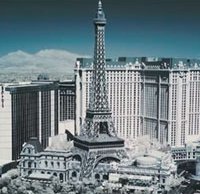
Haunting infrared footage of Las Vegas was made with a modified Sony RX100 IV

Sony's RX100-series cameras are well known for providing some of the best image quality one can get without going to a larger, interchangeable lens camera. The latest version, the RX100 IV, also introduced some pretty incredible movie features, like 4K resolution and the ability to capture bursts of HD video at a blistering 250 frames per second.

None of that was enough for filmmaker Phillip Bloom, who has traveled the world shooting projects for numerous clients, from the BBC to CNN, but who is equally known for his love of novel filmmaking technology. He was a pioneer of DSLR video and has been tapped by manufacturers to produce product announcement videos, such as his Panasonic GH3 launch film, Genesis.

So when Bloom took his Sony RX100 IV to Las Vegas, it was no ordinary RX100 IV. Instead, as first seen in PetaPixel and explained in detail by Bloom in a blog post, it had its infrared-blocking filter removed and replaced by a special infrared pass filter, a service provided by a company called Life Pixel. With this modification, Bloom's camera can record video beyond the range of light visible to the human eye. It is his latest of now three cameras that have been modified for this purpose.

Related: Sony RX100 IV Review

The process of infrared photography is nothing new, but by combining it with such a compact, capable camera, the results of Bloom's experiment are striking. The finished piece (as much as an experiment is ever finished) is simply titled "Las Vegas in Infrared" and was shot primarily using the RX100 IV's 250 FPS video burst mode from the seat of a car as Bloom drove through Vegas. The slow movement of people on the sidewalks and the strange colors, accompanied by Beethoven's Seventh Symphony, show the city in a way that is both recognizable yet strangely foreign. It could easily serve as the intro to some sort of dystopian science fiction film.

For more details on the project and the camera that made it possible, head over to Philip Bloom's blog.


Source: Haunting infrared footage of Las Vegas was made with a modified Sony RX100 IV

Wednesday, June 8, 2016

Olympus develops prototype image sensor that captures color and near-infrared simultaneously

Japanese imaging specialist Olympus in partnership with researchers from the Tokyo Institute of Technology have developed a prototype image sensor capable of capturing both color and near-infrared information simultaneously.

The prototype sensor is able to pull off this feat by utilizing a modified Bayer RGB filter. As Digital Trends explains, most image sensors in use today employ this type of sensor which dictates which pixels capture which colors. The standard layout is known as RGGB (red, green, green, blue) and can be seen in the graphic below.

Olympus' prototype replaces the red or blue pixel on every other sequence with a near-infrared pixel which allows it to capture near-infrared data. The result, of course, is a sensor that can capture both color and near-infrared information with a single click of the shutter.

A camera equipped with a hybrid filter such as this could be useful in a variety of fields including robotics, agriculture, medical imaging and security.

Personally, I'm interested in seeing how it would perform compared to digital cameras that have been modified specifically for infrared photography. I dabbled in the area of false color infrared photography briefly several years back although admittedly, I never fully grasped the exact specifics of what I was doing.

Nevertheless, I was able to capture a handful of decent images and wouldn't mind trying it again sometime.

Lead image courtesy Alex Yeung, Shutterstock


Source: Olympus develops prototype image sensor that captures color and near-infrared simultaneously

Olympus' experimental image sensor shoots color and near-infrared simultaneously

Olympus has partnered with the Tokyo Institute of Technology to develop a new imaging sensor that is capable of capturing both color information and near-infrared information simultaneously. This is notable because most modern sensors available these days are only capable of one or the other, color or infrared.

The sensor works by modifying the standard Bayer RGB sensor layout and incorporating a NIR, or near-infrared pixel, into the layout. Traditional image sensors, like the one in your smartphone or digital camera, are based on what is called the Bayer filter. This is an arrangement of color filters over the image sensor that allow specific pixels to only capture the color of the filter above it. The traditional layout is RGGB (Red, Green, Green, Blue), as you can see in the example below.

a standard bayer arrangement

A standard Bayer arrangement

How this new Olympus sensor differs is by removing the red or blue pixel on every other sequence of pixels and replacing that with a NIR pixel to capture the near-infrared image information. The result is an image sensor that is both capable of capturing color information as well as near-infrared information. This could be incredible useful for applications like video surveillance cameras, and other similar uses in which the users would have use for both color and near-infrared information.

As you can see by the images (see below), the sensor is still in the prototype phase, so don't expect your next smartphone to have this capability. But that said, this proves that the concept is possible, and now the team over at Olympus and TIT can focus on improving the technology.

news_10910_2

Related: From 4K and full-frame to drones and VR, looking at digital imaging in 2016

This could also be of interest to infrared photographers, who in some cases spend hundreds of dollars to convert their standard Bayer-based cameras into infrared cameras. If this sort of technology made its way into the digital camera realm, many of these individuals would likely be incredibly intrigued at the possibility of being able to capture near-infrared images as well as standard color or black-and-white images.

The technology is still a fair way off from that point, but its certainly an exciting development in the imaging sensor world.


Source: Olympus' experimental image sensor shoots color and near-infrared simultaneously

Monday, June 6, 2016

Art And Business Come Together In Fairmount

PHILADELPHIA (CBS) — The Art Museum area had a very artsy feel to it on Saturday afternoon.

Unexpectedly nice weather made it a perfect day for the Fairmount Avenue Arts Crawl.

Kevin Moran with the Fairmount CDC says the art consisted of paintings, sculptures and photography:

"We transform roughly 25 store fronts in the Art Museum area of Philadelphia into popup art galleries for the day. We program the sidewalk with kids activities, there's vendors on the street, we have live music."

Russell Brown was showcasing his cityscapes of Philly.

"I try to put Philadelphia in its best light," he tells KYW Newsradio. "I do long exposures and infrared photography to really show Philadelphia for the beautiful place that it is."

Russell Brown showcasing some of his art work. Photo credit: KYW's Andrew Kramer

Russell Brown showcasing some of his art work. Photo credit: KYW's Andrew Kramer

One of the more unique features was the Haiku Mile, a collection of neighborhood haikus placed along the sidewalk throughout the festival. And in front of Neil Patterson's store….

"I'm doing pottery demonstrations for the public to come and watch," he explains. "Get a little education on what we do here and just get to see something exciting to look at."


Source: Art And Business Come Together In Fairmount