Pages

Sunday, July 10, 2016

Farmers Tap Into Drone Industry

VALLEY SPRINGS, S.D. -

It's the latest technology that has taken still imagery to new heights.

But business owners and event planners aren't the only ones tapping into it.

Farmers have now taken interest in using drones.

They say it helps them become better decision makers when it comes to managing their crops.

"It would be great to see what those ancestors think about what we're doing now," says American Soybean Association Board Member Kevin Scott. "My great grandfather moved here in 1888, so everything was done by horse and buggy."

Times have definitely changed the farming industry.

What once was an all-manual labor task has now advanced to using technology like drones.

Scott says these unmanned air crafts are helping farmers better manage their crops.

"There are a lot of variables that we can't see from the road," he explains. "Typically we drive by on the road and say it's good enough, looks good, and there are some things you want to take a look at."

To do so, Scott uses the images and videos his drone takes.

It only takes a simple click of a button to take the picture.

But the result is much more invasive.

"Snap a picture and you can take that home, put it on your computer, and blow it up," says the farmer. "Then you can count the bugs on the plant. If you have enough bugs to treat, then treat it. If you don't, good. But you don't have to walk a half a mile out in the field where you can barely walk and do the counting; you can fly out there and do it."

Some of Scott's drone images show crops that have died from spraying problems, planting errors and the effects of a bad storm.

"This gives us an opportunity to look at those things and determine whether we are doing a good job with our inputs," says Scott, which is important with all the changes.

Not just in technology, but in an increase in demand as well.

"We're feeding so many more people in ag and we have to be good at it, because the world population is continues to grow, people want to eat," explains Scott.

Scott says with all these changes, it's important for consumers to know what's going on in the farming world.

To help with this, an organization called Hungry For Truth of South Dakota was created.

It's another step the industry has taken, but he doesn't think it will stop here.

"We're just scratching the surface," says Scott. "Technology is coming that it would take infrared photos, NDVI photos that are much more intense. They'll show the temperature difference in the crop, if a crop gets hot it means it's sick if it's cool its better. So we're just scratching the surface on what the drone technology is going to do for us."


Source: Farmers Tap Into Drone Industry

Photographer, teacher puts work on exhibit

Photographer Wendy Costa is on exhibit with "Photographs in Infrared" in Oliver Wolcott Library's Jamie Gagarin Community Room and Gallery in Litchfield.

Costa has been an avid photographer since inheriting her father's Argus C3 rangefinder camera in high school. In graduate school at the University of Michigan, she studied with Joanne Leonard, who encouraged her to combine photography with drawing, painting, and collage.

After the completion of her MFA degree, Costa pursued other alternative photography media, including Polaroid transfers. This medium allowed her to combine drawing, painting, and collage with photography.

In 2014, inspired by the work of Laurie J. Klein, Costa began to work with digital infrared photography.

A Litchfield resident, Costa has been teaching art for 35 years, the last 26 years at Wamogo Regional High School where she teaches photography, among other art classes. Her work has been shown in many venues including the Center for Photogra phic Art, University of Connecticut, Litchfield Historical Society and Westover School.

The exhibit ends Aug. 23. The library is at 160 South St. For details, call 860-567-8030 or visit owlibrary.org.

Follow Us


Source: Photographer, teacher puts work on exhibit

Thursday, July 7, 2016

Wendy Costa’s ‘Photographs in Infrared’ are featured exhibit

LITCHFIELD >> The Oliver Wolcott Library, 160 South St., Litchfield, will featured "Photographs in Infrared," a collection of photographs by educator and resident Wendy Costa, during the months of July and August in the library gallery.

Costa has been an avid photographer since inheriting her father's Argus C3 rangefinder camera in high school. In graduate school at the University of Michigan, she studied with Joanne Leonard, who encouraged her to combine photography with drawing, painting, and collage.

After the completion of her MFA degree, Costa pursued other alternative photography media, including Polaroid transfers. This medium allowed her to combine drawing, painting, and collage with photography.

In 2014, inspired by the work of Laurie J. Klein, Costa began to work with digital infrared photography.

In infrared photography, live green foliage and grass reflect infrared rays, so they appear white. Blue skies and deep water absorb infrared rays, so they appear black. There is a mystery to the medium which she loves — she never quite knows how the picture is going to appear until she clicks the shutter, she said.

A Litchfield resident, Wendy Costa has been teaching art for 35 years, and has spent the last 26 years at Wamogo Regional High School in Litchfield, where she teaches photography, among other art classes. Her work has been shown in many venues including the Center for Photographic Art, University of Connecticut, Litchfield Historical Society, and Westover School.

The exhibit runs through Aug. 23 An artist reception will be held on Thursday, July 7, from 5-7 p.m. For information, call the library at 860-567-8030 or visit www.owlibrary.org.

LITCHFIELD >> The Oliver Wolcott Library, 160 South St., Litchfield, will featured "Photographs in Infrared," a collection of photographs by educator and resident Wendy Costa, during the months of July and August in the library gallery.

Costa has been an avid photographer since inheriting her father's Argus C3 rangefinder camera in high school. In graduate school at the University of Michigan, she studied with Joanne Leonard, who encouraged her to combine photography with drawing, painting, and collage.

After the completion of her MFA degree, Costa pursued other alternative photography media, including Polaroid transfers. This medium allowed her to combine drawing, painting, and collage with photography.

In 2014, inspired by the work of Laurie J. Klein, Costa began to work with digital infrared photography.

In infrared photography, live green foliage and grass reflect infrared rays, so they appear white. Blue skies and deep water absorb infrared ra ys, so they appear black. There is a mystery to the medium which she loves — she never quite knows how the picture is going to appear until she clicks the shutter, she said.

A Litchfield resident, Wendy Costa has been teaching art for 35 years, and has spent the last 26 years at Wamogo Regional High School in Litchfield, where she teaches photography, among other art classes. Her work has been shown in many venues including the Center for Photographic Art, University of Connecticut, Litchfield Historical Society, and Westover School.

The exhibit runs through Aug. 23 An artist reception will be held on Thursday, July 7, from 5-7 p.m. For information, call the library at 860-567-8030 or visit www.owlibrary.org.


Source: Wendy Costa's 'Photographs in Infrared' are featured exhibit

Wednesday, July 6, 2016

Can Apple’s New Infrared Patent Really Disable Your iPhone?

apple-magnifying-glassOn Tuesday, June 28, Apple was granted a new patent, U.S. Patent No. 9,380,225, entitled "Systems and methods for receiving infrared data with a camera designed to detect images based on visible light." The patent essentially discloses a method for a smartphone's camera to receive data over infrared waves—data that could alter functionality of the phone. Since the grant of the patent there has been a viral outpouring of articles on using this technology to disable photography and video capture, particularly at live concerts and theater events. While this apparentl y invasive tech may be something to keep an eye on, it's important to consider if this can be implemented tomorrow, in a future iPhone, or in an Apple device further down the road. How soon should we start to worry?

For instance, the Washington Post said that musical artist "Alicia Keys has her fans lock their smartphones in a gray, rubbery pouch for the duration of her shows" but that thanks to the new patent, "these measures may soon be unnecessary." CBS News questioned, "What if the technology was leveraged to block photo and video at a political protest or another sensitive event, making recording of these events impossible?" CBS pointed to the recent sit-in by House Democrats as an event that might not have been broadcast but for smartphones, saying, "Such [live streaming] wouldn't be possible if the newly-patented technology was in place" to enforce the House's rules prohibiting recording by cell phone.

The New York Daily News did not disappoint with their strong reaction and suggested that "Apple's proposed disabling function could also be useful to police, as [the] battle for the right to record officers continues raging on." Progressive news site CommonDreams dubbed the patent the "iCensor" and a "Kill Switch" for iPhone cameras. The A.V. Club simply called the patent "super evil." Even the popular rumor-debunking site, Snopes, issued a post to clarify that "Ordinary cameras (and portable cameras not manufactured or licensed by Apple) would not be affected by this particular blocking technology." Perhaps this technology truly is an over-reach, but is now the time to panic? Maybe.

The Patented Technology

The truth is that Apple has specifically claimed in the patent a method/system that could disable smartphone functions (i.e., send "infrared data [that] comprises a disable command to render a function of an electronic device temporarily inoperable"). The good news is that no one can use this precise method of image capture without paying Apple a presumably large sum of money.

The patent specifically discloses a capable camera:

Camera 107 can include any suitable device for detecting images based on visible light. For example, camera 107 can detect single pictures or video frames based on visible light. Camera 107 can also detect infrared signals with encoded data. For example, camera 107 can detect images that include infrared signals. In some embodiments, camera 107 may include a filter for blocking light of particular wavelengths or ranges of wavelengths. For example, camera 107 can include a filter that blocks infrared light near the edge of the visible light spectrum (e.g., near 700 nm) but not infrared light with a substantially longer wavelengths (e.g., near 850 nm or 950 nm).Camera 107 can include any suitable type of sensor for detecting visible and infrared light in an environment. In some embodiments, camera 107 can include a lens and one or more sensors that generate electrical signals. The sensors of camera 107 can be provided on a charge-coupled device (CCD) integrated circuit, for example. (col. 4, ll. 30 – 46).

As a quick physics refresher-lesson, infrared is the area of the electromagnetic spectrum that is a longer wavelength than red and is invisible to the human eye. Infrared, like the signals sent by your TV remote control, is directional and needs to be aimed. A writer at Tech Insider noted the direct line of sight nature of infrared "is perfect for the application described in Apple's patent, as it won't disable your camera unless you're pointing it at something or someone you're not supposed to." However, most people are just concerned there might be a backdoor to disabling their iPhone.

Current iPhone Cameras

Your first thought should be: "if infrared is invisible, do current iPhone cameras 'see' infrared?" The short answer is that the rear-facing cameras on recent iPhones filter out or cut IR waves.

Unfiltered or poorly filtered digital cameras can pick up infrared waves that reflect off of the object, not necessarily capturing the infrared waves emitted by the objects like a thermal camera would. Accordingly, some photographers firmly believe that since a camera's CCD or CMOS silicon-based sensors are sensitive to near infrared waves (700 – 1,050 nm), the resulting digital images containing infrared effects are contaminated and not as aesthetically pleasing. This is typically a result seen as some overexposure in the red channel. A 2011 Wired article discusses the filter feature as an image cleaning benefit of the images captured by the rear-facing camera in the iPhone 4s.

Apple boasts that models after the iPhone 4s include a "Hybrid IR filter" for "better color accuracy" and "more color uniformity." Teardown site iFixit.com lists "Five-element lens, Hybrid IR filter, [and a] Sapphire crystal lens cover" as key pieces in the iPhone 6's rear-facing 8-megapixel iSight camera. From a teardown photo of the iPhone 5s' Sony camera shared by System Plus Consulting, the filter appears in the rear-camera housing, behind the lenses and on top of the CMOS chip.

A simple test to see if your camera cuts out IR is to point a TV remote control at the camera and observe if the light appears on the LCD. For most phones it appears that the front-facing camera does not filter out IR, but the FaceTime cameras do not appear to be relevant to this patent. Theoretically, with a software update and IR emitters in place, Apple could try to restrict "selfies" with the IR data tomorrow, but your body would likely block most of the infrared beam and the phones would only intermittently receive a transmitted disabling command.

Now, with the more important rear-facing cameras having an IR filter, there is a big issue: does the iPhone's Hybrid IR Filter cut all wavelengths prior to capture or does the iPhone receive some of the longer wavelength IR and digitally process more IR effects out?

Here, we have to make some assumptions based on some very sound logic: Apple wants parts and production costs to be as cheap as possible. That reasoning would lead one to conclude that the filter is an inexpensive and part of the camera housing rather than multiple extra chips or a software filter relying on image processing data. Moreover, such filters are known in the industry and known to be glass or the cheaper, more malleable plastic with a chemical coating. Typically, these types of filters cut infrared as well as ultraviolet waves as UV are electromagnetic waves that, while on the other side of the ROYGBIV visible spectrum, may also contaminate images captured with a CCD or CMOS chip. Parasam believes that Apple moved from a simple thin-film IR in the iPhone 4 to a "thick-film" combination IR/UV filter in the iPhone 4S rear camera. Such filters typically have the ability to cut both UV rays below 390nm and IR rays above 700mn leaving just the visible spectrum.

So the straightforward conclusion is that in order to save costs the iPhone's Hybrid IR filter likely blocks the problematic parts of the infrared spectrum between roughly 700 nanometers and 1050 nm. A few message board posts seem to agree, if that helps. The alternative, for example, an optical bandpass filter that selectively transmits a portion of the IR spectrum and rejects other wavelengths, would likely be a more complicated, custom solution with a correspondingly higher price tag.

Accordingly, it's more likely than not that the current crop of iPhones cannot receive IR data via the rear-facing camera due to the Hybrid IR Filter.

Implementation of the Technology

Hopefully, after better understanding infrared and the iPhone's camera capabilities, there is an appreciation that Apple's infrared disabler tech cannot become a reality from an iOS update over night with the current models of iPhones. Specifically, with regard to the phones' rear-facing cameras, there would likely need to be new cameras in a future iPhone hardware update to eliminate or substitute the current infrared cutting filter. According to the patent, such a new IR filter would likely block IR from 700 – 850 nm that is closer to the visible (red) spectrum, but allow longer wavelengths of 850 or 900 nm and above to pass through. The IR wavelength window in the future filter likely would not have to be too wide. Again, designing and implementing custom IR cutting filter, along with a UV filter, would not be inexpensive.

Secondly, the IR data transmitting devices would have to be made and installed. This, however, would not be very difficult, as infrared emitters and blasters are well-known and they could be installed in venues across the world or mounted by each touring artists or band as they come through. These could be installed right next to the visible lasers, lights, and strobes.

The difficulty for Apple would likely come with limiting the infrared signals' duplication by competitors and/or hackers. IR signals, like your remote control, can easily be captured and repeated. If a nefarious person were to mimic the hypothetical concert's IR signal, he could potentially disable your device outside of the event. Perhaps Apple could include some type of data validation via accessing an internet address, double-checking a GPS location, or receiving a corresponding near-field radio signal, but that would likely render the IR signal superfluous. There should be more efficient solutions to prevent photography than relying on infrared.

Especially as one would expect that third-party iPhone case makers would come to the public's rescue if this technology were to be implemented. Such a removable case could include an IR cutting filter for use in bypassing the disable commands. For example the patent discloses that "if image processing circuitry 218 determines an absence of infrared signals with encoded data in an image, it may route the image to display 216 for displaying the image" (col. 6, ll. 63 – 66). This seems relatively shortsighted on Apple's part, especially considering the patent fully recognizes that "in embodiments where an infrared data includes commands to temporarily disable a device function, a user may not be able to set ['ON' or 'OFF'] configuration options that override the disable commands" as it would "defeat the purpose of providing disable commands through infrared data" (col. 13, ll. 8 – 14). Perhaps Apple is secretly developing better tamper protection as a temp orary filter for concert-going or civilly defiant iPhone users seems almost too easy for a solution to overcome an infrared hurdle.

The next question would be Apple's motivation for implementing the disable commands. While obviously this tech could very well help Apple with their relationships with mega musical artists looking to limit the camera phone use at concerts, the public uproar caused by the initial impression of the patent has already triggered 'hot takes' in social media and much worry in the consumer base. Moreover, Apple altering or removing the infrared filter might undo many of the recent smartphone photographic advancements. Relying on the phone to process the image—risking creation of artificial-looking photos—does not seem like a prudent solution that the Cupertino engineers or executives would get behind.

As for the forthcoming iPhone 7 models, the size of the camera hole appears to be a big focus in the rumors. For instance, a dual-lens camera appeared on an allegedly leaked photo of the iPhone 7 Plus. Engadget apparently found a Chinese spy-shot of the iPhone 7 with a "larger CMOS sensor." Camera-specific upgrades, along with newly introduced features like Live Photos and 4K video via recent hardware updates, would make it ridiculous to think that Apple would sacrifice photograph image quality in order to create a disabling-by-infrared feature. Still keep an ear out as any changes to the camera will likely fly under the radar, especially if Apple formally announces removal of the headphone jack in their future phone.

If anything, one would expect Apple to improve the camera and shelve the infrared disabler. Mashable noted that "Given its history with protecting iPhone users' freedom and privacy [from the FBI], it would be very un-Apple like of the company to implement such a tech." BBC News quoted Stuart Miles, founder of gadget site Pocket Lint, as saying "It could harm Apple in the eyes of some people" and that "People like freedom of speech – and who is Apple to tell me I can't record something?"

Despite the media pointing at music artists' recent displeasure with the amateur photographers, the operational and intangible costs of implementing the patent's technology appear to be adding up for Apple. So maybe Apple only intends to sit on this patented technology so that no one else can use it? Right. And everyone will naturally adopt courteous camera phone habits the day after that press release!

This is provided for informational purposes only, and does not constitute legal or financial advice. The information expressed is subject to change at any time and should be checked for completeness, accuracy and current applicability. For advice, consult a suitably licensed patent professional.


Source: Can Apple's New Infrared Patent Really Disable Your iPhone?

Tuesday, July 5, 2016

Wendy Costa’s ‘Photographs in Infrared’ are featured exhibit

LITCHFIELD >> The Oliver Wolcott Library, 160 South St., Litchfield, will featured "Photographs in Infrared," a collection of photographs by educator and resident Wendy Costa, during the months of July and August in the library gallery.

Costa has been an avid photographer since inheriting her father's Argus C3 rangefinder camera in high school. In graduate school at the University of Michigan, she studied with Joanne Leonard, who encouraged her to combine photography with drawing, painting, and collage.

After the completion of her MFA degree, Costa pursued other alternative photography media, including Polaroid transfers. This medium allowed her to combine drawing, painting, and collage with photography.

In 2014, inspired by the work of Laurie J. Klein, Costa began to work with digital infrared photography.

In infrared photography, live green foliage and grass reflect infrared rays, so they appear white. Blue skies and deep water absorb infrared rays, so they appear black. There is a mystery to the medium which she loves — she never quite knows how the picture is going to appear until she clicks the shutter, she said.

A Litchfield resident, Wendy Costa has been teaching art for 35 years, and has spent the last 26 years at Wamogo Regional High School in Litchfield, where she teaches photography, among other art classes. Her work has been shown in many venues including the Center for Photographic Art, University of Connecticut, Litchfield Historical Society, and Westover School.

The exhibit runs through Aug. 23 An artist reception will be held on Thursday, July 7, from 5-7 p.m. For information, call the library at 860-567-8030 or visit www.owlibrary.org.

LITCHFIELD >> The Oliver Wolcott Library, 160 South St., Litchfield, will featured "Photographs in Infrared," a collection of photographs by educator and resident Wendy Costa, during the months of July and August in the library gallery.

Costa has been an avid photographer since inheriting her father's Argus C3 rangefinder camera in high school. In graduate school at the University of Michigan, she studied with Joanne Leonard, who encouraged her to combine photography with drawing, painting, and collage.

After the completion of her MFA degree, Costa pursued other alternative photography media, including Polaroid transfers. This medium allowed her to combine drawing, painting, and collage with photography.

In 2014, inspired by the work of Laurie J. Klein, Costa began to work with digital infrared photography.

In infrared photography, live green foliage and grass reflect infrared rays, so they appear white. Blue skies and deep water absorb infrared ra ys, so they appear black. There is a mystery to the medium which she loves — she never quite knows how the picture is going to appear until she clicks the shutter, she said.

A Litchfield resident, Wendy Costa has been teaching art for 35 years, and has spent the last 26 years at Wamogo Regional High School in Litchfield, where she teaches photography, among other art classes. Her work has been shown in many venues including the Center for Photographic Art, University of Connecticut, Litchfield Historical Society, and Westover School.

The exhibit runs through Aug. 23 An artist reception will be held on Thursday, July 7, from 5-7 p.m. For information, call the library at 860-567-8030 or visit www.owlibrary.org.


Source: Wendy Costa's 'Photographs in Infrared' are featured exhibit

The Unseen: infrared photographs of the invisible

Schilt Publishing's new release, The Unseen – An Atlas of Infrared Film is a comprehensive, almost academic, exploration of several uses of infrared film by documentary photographer Edward Thompson. For the better part of the last decade, Thompson has travelled the world – from Ukraine to Northern India – chasing stories and locations to photograph with the last 52 rolls of Kodak Aerochrome Infrared film.

Studies in Pollution #9. Hyde Park & Buckingham Palace from The City. (2015). England. 120mm CIR Photograph.Studies in Pollution #9. Hyde Park & Buckingham Palace from The City. (2015). England. 120mm CIR Photograph. The view from Rose Court from The Village. (2010). England. 120mm CIR Photograph.The view from Rose Court from The Villag e. (2010). England. 120mm CIR Photograph.
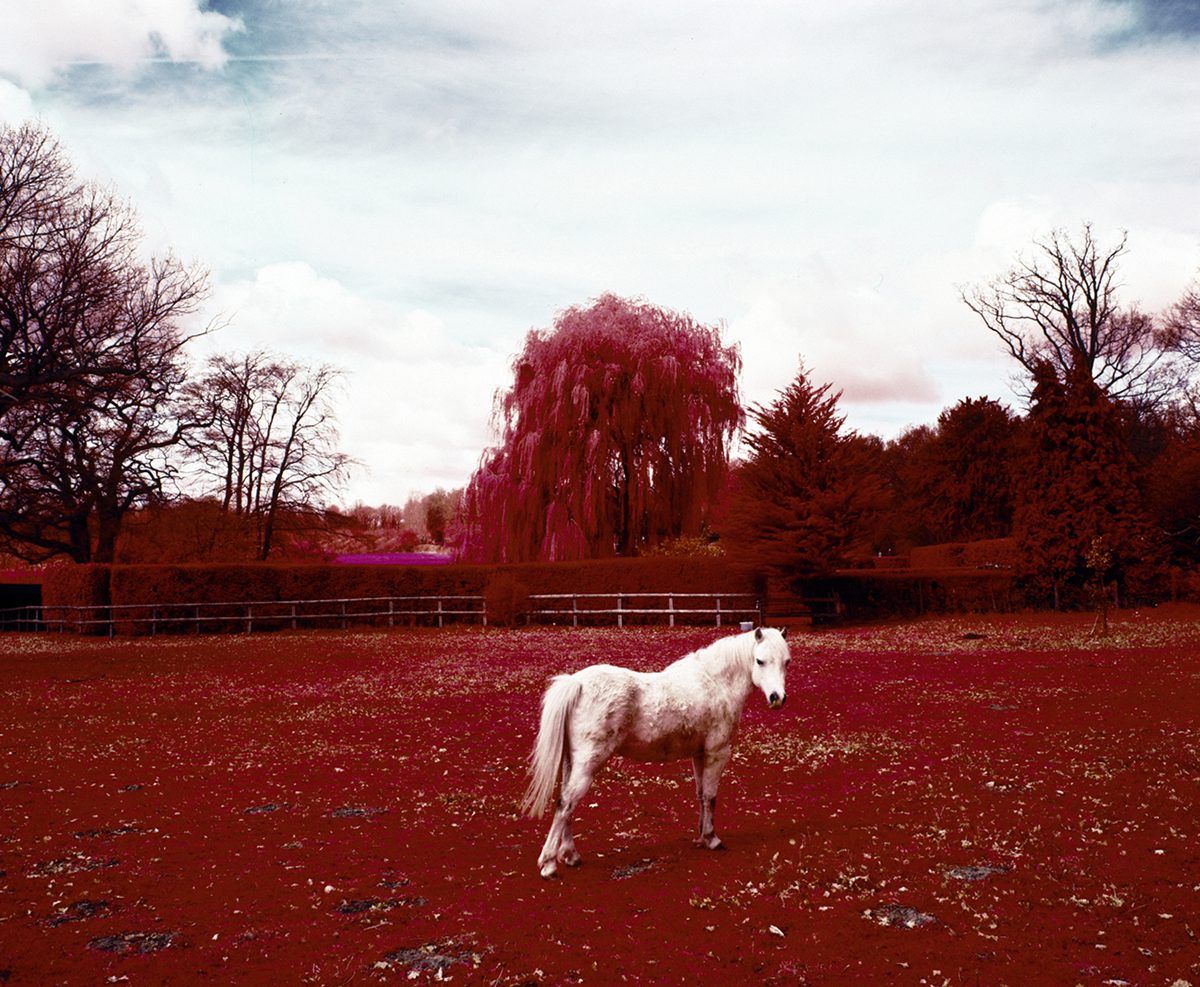
In his foreword, Thompson recounts a childhood fascination with the spirit world, his membership of a Ghost Club and failed attempts at photographing ghosts using infrared film. This strange obsession with capturing the paranormal in photographs, lead to a personal exploration of what he calls "other more respected fields of science" like medicine, geology, botany and astronomy where infrared film has been historically used towards other ends. For example in forestry, where the infrared colour film can be used to reveal the health of certain species of trees.

After the Red River Valley. (2012). India. 120mm CIR Photograph; Here infrared film reveals flood damage. All the soil appears white, which indicates that it is devoid of nutrients and life after the flood. Soil with healthy grass and vegetation typically appears bright red on colour infrared film. After the Red River Valley. (2012). India. 120mm CIR Photograph; Here infrared film reveals flood damage. All the soil appears white, which indicates that it is devoid of nutrients and life after the flood. Soil with healthy grass and vegetation typically appears bright red on colour infrared film.

In the book his body of work has been presented in twelve chapters; infrared film is used to a different effect in each. For instance, in a chapter titled The Red Forest he documents the most radioactive forest in the world, where the film itself was affected by radiation, manipulating the appearance of the prints. In another chapter titled The City, stunning aerial shots of London reveals a reddish band of smog and pollutants.

Hand #6 from The Vein. (2015). 120mm CIR Photograph. In this series Thompson uses historic medical photography techniques, which present a "hyper-real" nudity by making the skin appear thinner and the veins more pronounced. Hand #6 from The Vein. (2015). 120mm CIR Photograph. In this series Thompson uses historic medical photography techniques, which present a "hyper-real" nudity by making the skin appear thinner and the veins more pronounced.

What's perhaps most striking about this photo book is how diverse each chapter and series of photographs is not just in subject matter, but also in aesthetic – it is easy to mistake the book for an anthology featuring the work of several photographers, when it is in fact one artist's triumphant homage to the medium of colour infrared film photography.

Astrophotograph of the Flame Nebula from The Beginning and the End. (2016). 35mm CIR Photograph. Glaciers pictured here appear an intense blue on infrared film. The Northern Lights and a nomaly. (2016). Iceland. 120mm CIR Photograph. Glaciers pictured here appear an intense blue on infrared film. storm approaching Pripyat from The Red Forest. (2012). Exclusion Zone, Chernobyl. 120mm CIR Photograph.Storm approaching Pripyat from The Red Forest. (2012). Exclusion Zone, Chernobyl. 120mm CIR Photograph.
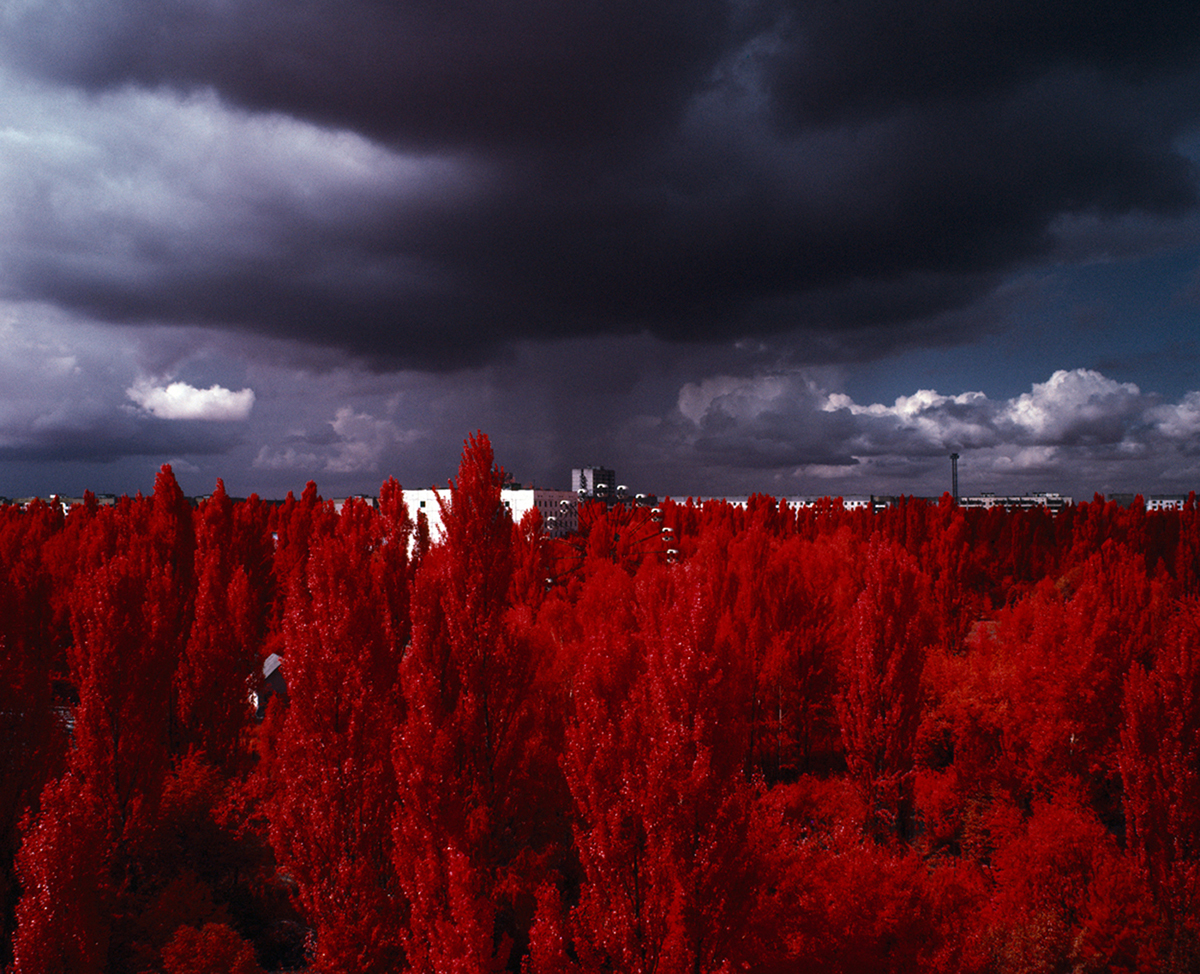
The Unseen – An Atlas of Infrared Plates is published by Schist Publishing (£30) See schiltpublishing.com; edwardthompson.co.uk

Lead image: Studies in Pollution #7. The River Thames from The City. (2014). England. 120mm CIR Photograph.

The Unseen – An Atlas of Infrared Plates by Edward Thompson, published by Schilt Publishing. Design: Heijdens Karwei, AmsterdamThe Unseen – An Atlas of Infrared Plates by Edward Thompson, published by Schilt Publishing. Design: Heijdens Karwei, Amsterdam
Source: The Unseen: infrared photographs of the invisible

Monday, July 4, 2016

Chasing structures from the past

MILE-LONG Barracks was taken at a wide angle, with the landscape larger, and the remains appearing to shrink toward the vanishing point.

MILE-LONG Barracks was taken at a wide angle, with the landscape larger, and the remains appearing to shrink toward the vanishing point.

Visitors are mesmerized by the blow-ups of misty waterfalls and awe-inspiring landscapes in the Philippines. Benigno "Bengy" Toda III holds the distinction of being the first photographer to have a permanent collection at National Art Museum.

Ask how Toda achieves such powerful images, he replies in Tagalog: "Look in your backyard. The beauty is just there." He adds that he doesn't glamorize squalor or garbage.

Toda—son of former Philippine Airlines chair Benigno Toda Jr.—has traveled the world and photographed breathtaking panoramas and dramatic vignettes. Yet he ends up being lured by the natural splendor of the Philippines.

On the other hand, his latest exhibit, "Chasing Bridges" at Provenance Gallery, shows the surreal beauty of heritage bridges in the southern Tagalog region and the skeletons of the military barracks in Corregidor.

The photographs of Spanish bridges are of utmost significance, says Toda. They are reminders of the handwork of the Filipinos and all but forgotten legacy of the Spaniards.

 Extensive research

Architect and heritage conservationist Augusto Villalon once wrote a column citing the extensive research of professor Manuel Maximo Lopez del Castillo-Noche  in the book "Puentes de España en las Filipinas (Spanish Colonial Bridges in the Philippines)."

In a country separated by water, these bridges spanned deep gorges and rivers. The arches supported the overpass. The Spaniards constructed the bridges to link communities for Christian evangelization and to facilitate the trade of goods throughout the country.

Villalon quotes the book as saying that the bridges were a testament to the engineering genius and determination of the Filipino and Spanish builders.

Toda recalls that an artist/mountaineer in his company, Studio 58 Lab 10, had tipped him of the eerie Spanish bridges in Quezon. They Googled them and did a pre-production game plan for the shoot.

With a team of two assistants and a driver, plus several cameras, they hopped on a pick-up truck.

"One day, at 3 a.m., we went out and looked for them," recounts Toda. "I'd go down into water, wade through the dirty streams, see the feces floating. Ugh! You just have to do it."

He spends time looking for the right angles that capture the grandeur or desolation of old structures, and their character, ravaged by time and nature. "In the end, it's very rewarding. These are the only high-end pictures of the bridges and printed 45 x 65," he notes.

One of the most important bridges is Puente Malagonlong in Tayabas, Quezon. The 136-meter length makes it the longest bridge built by Filipino forced labor in 1840, and inaugurated in 1850. It has been declared a National Cultural Treasure by National Historical Commission of the Philippines. Today, the small balconies are used for pedestrians.

BENGY Toda: Giving the Philippines a beautiful perspective

BENGY Toda: Giving the Philippines a beautiful perspective

Puente de Alitao, built in wood by the Spanish governor general in 1798 and then made into stone by the friars in early 19th century, is still used today. Toda's team extensively retouched the photo by removing the ghastly telephone wires to show the bridge's bucolic charm.

Ravine

Toda recalls the search for Puente del Capricho in Majayjay, Laguna: "We had to look down the ravine and see if the arch was there. Most of the time, we jumped because it was steep."

His image of Puente del Capricho captures the arch protruding out of the layers of  dense ferns, creepers emerging from its crevices and trees.

The photographer stood at the foot of the ravine, capturing the steepness and loneliness of being in an abyss.

Puente del Capricho also reveals how the combined control of the Spanish government and the friars resulted in the muddle of liability. It's been said that the friars smacked the buttocks of the Filipino workers. Hence, the laborers left the project unfinished with only one arch in 1852.

An official report to the Spanish governor general cited that the bridge ignored scientific principles. It was nicknamed Puente del Capricho or the Bridge of Whims because the construction was led by a friar who was ignorant of engineering.

Toda also went to Corregidor to photograph vestiges of the Mile-Long Barracks and Middle Barracks. Their skeletal framework created a repetition of boxes that spanned the island, creating an impression of a bridge.

Toda chose infrared or IR photography, where the range of light is beyond what the normal eye can distinguish. It was popular in the war to show marked differences between undergrowth and buildings, better distinguishing hidden enemy sites.

IR photography is considered an art form, whose allure lies in its dreamy ambience and vaporous and sometimes surreal appearance. For Toda, IR photography allows him to play with contrasts in texture.

PUENTE de Alitao shows the contrast of the dark structures and the lightness of the foliage, which adds depth to the arches.

PUENTE de Alitao shows the contrast of the dark structures and the lightness of the foliage, which adds depth to the arches.

Leaves, grass and clouds reflect greater quantities of IR light, resulting in white patterns. Stones, concrete and skies soak up the IR and appear darker, almost black in photos.

In photographing historic structures, Toda favored a straightforward composition to showcase their haunting beauty. The surrounding scenery

—the contrast of black rocks against white vegetation, cottony clouds etched against the black skies—puts the architecture in their present context.

"I like the drama it brings," says Toda on using IR photography for the bridges and barracks. "It shows that once there was a life. Their destruction is heartbreaking."

The exhibit runs until today, July 5, at Provenance Gallery, Shangri-La at the Fort, Taguig.


Source: Chasing structures from the past