Pages

Friday, August 25, 2017

Barr Lake Park in Infrared

In infrared photography, the film or image sensor used is sensitive to infrared light. The part of the spectrum used is referred to as near-infrared to distinguish it from far-infrared, which is the domain of thermal imaging. Wavelengths used for photography range from about 700 nm to about 900 nm.

As I write this, my local supermarket is putting up Halloween displays, which means only one thing: The end of infrared photography season is around the corner. And while I have written that you can shoot infrared in the Winter, it doesn't have the same look or anyway the look I prefer. In the Northern Hemisphere, Fall starts on September 22, so less than a month from now the leaves on trees in my favorite infrared shooting areas will start to disappear. So I'm urging all the infrared photography fans reading this to get out this week, this weekend and make some shots while leaves are still on deciduous trees.

Before moving to Daisy Hill and being able to walk to Bingham Lake, one of my favorite places to shoot outdoor portraits as well as infrared photography was at Barr Lake State Park, which entailed a five mile drive form my former home, which is where I made the above photograph.

Proving that timing is everything, this shot was made in Barr Lake State Park in October, the day be fore a big snowstorm was due to blow most of those leaves away. Camera was a EOS Digital Rebel Xti that had been converted to infrared-only capture by LifePixel and a Zeiss 18mm Distagon T* f/3.5 lens with an exposure of 1/125 at f/16 and ISO 400. It was converted to monochrome by Silver Efex Pro with a warm tone added by its coffee filter.

IR.book

My book, The Complete Guide to Digital Infrared Photography is currently out-of-print but copies are available from Amazon starting at $19.95, as I write this. Creative Digital Monochrome Effects has a chapter on IR photography and is available from Amazon with new copies under $10 and used copies selling for $2.55 (plus shipping) one of the bets book deals out their for what is my personal favorite book.

Related


Source: Barr Lake Park in Infrared

Thursday, August 24, 2017

How to shoot infrared without converting your camera

Infrared photos can be surreal, wonderful and a great way to try something completely new. However, if you want to shoot them you may have to convert your camera. Fortunately, there's an easier and cheaper alternative, and this video from Craig Roberts of e6 Vlogs shows you how to take infrared photos without altering the camera.

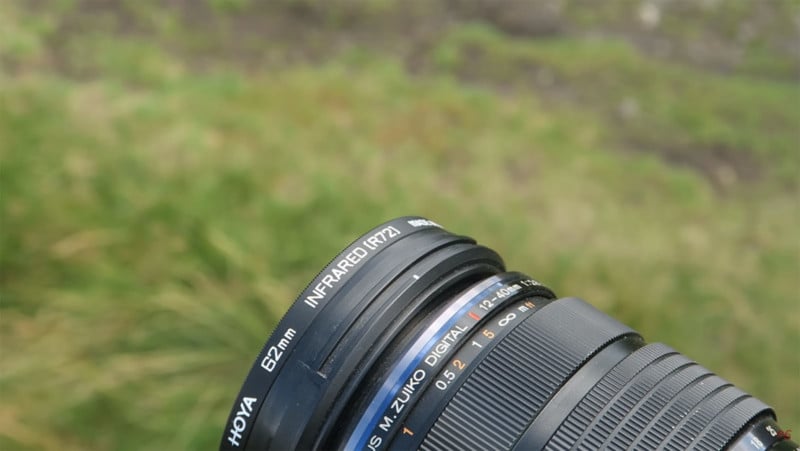
The easier way is to use the infrared filters. They're affordable and give pretty good results, but there are some tricks to shooting with them if you want to get correctly exposed, sharp images. So let's check out what you need to know before you add the IR filter onto your lens.

First of all, the filter is a great alternative because it's cheaper, and you can still use your camera to capture regular photos when you take it off. The filter blocks the visible light and allows the infrared light to pass through and create the photo. However, you need to remember that it absorbs about 10 stops of light, so you'll need to take all the photos with longer exposures and on a tripod.

Absorbs about 10stops of light, you have to use a tripod and a long exposure. Craig uses 5 sec at f/5.6 and ISO 400 on a sunny day, which usually gives him good results. On the Live View of some cameras, you should be able to see the exposure preview. However, not all cameras offer it and if you look through the viewfinder, you'll see dark, so set your exposure before putting the filter on.

Because of the longer exposure, keep in mind that the wind can make the foliage appear blurry. Sometimes it can create an interesting effect, but if it's not your goal – choose a day without the wind to take your IR photos. White we're at the weather conditions, keep in mind that these photos work best on a sunny day, because more IR light is reflected. On an overcast day, the results may not exactly be impressive.

Finally, as for the post-processing – Craig converts the photos to black and white and adds a bit of contrast and brightness tweaks, and that's pretty much it. But of course, you can adjust it to your liking.

Although this may seem a bit demanding, it's cheap and gives you more versatility because your camera remains intact. So, if you want to try something new and see if IR photography would suit you, I believe this is the way to go. At least for a start. If it grows on you – then think about converting the camera.

[The Easy Guide to Infrared Photography via FStoppers]


Source: How to shoot infrared without converting your camera

Wednesday, August 23, 2017

How to Try Out Infrared Photography Without Modifying Your Camera

Digital cameras usually have infrared filters on the sensor that work to block out almost all of the infrared information reaching it. To shoot infrared photos, photographers often have their camera converted to capture infrared light by removing this filter, but in turn the camera loses its ability to capture "normal" images. If you'd like to dabble with IR photography, there's an easier alternative.

If you're new to the world of infrared photography, altering a camera and restricting it to one narrow genre is probably not an attractive prospect. After all, what if you decide it's not for you?

In the 12-minute video above from e6 Vlogs, learn about the alternative way to try it out: by using specialized filters.

These filters screw onto the end of your lens and block all visible wavelengths of light. The small amount of infrared light that does manage to reach the sensor, despite the blocking filters, is then the only light available. Consequently, this means using very long exposures to create an image, but it's a cheaper alternative than making a camera sacrifice.

Remember, if you do this you'll need to compose and focus your shot before putting on the filter, otherwise you'll just see a black screen. Some cameras offer a Live View "boost" mode that brightens it up enough, but not all do.

(via e6 Vlogs via Fstoppers)


Source: How to Try Out Infrared Photography Without Modifying Your Camera

Tuesday, August 22, 2017

City Council recognizes Arts and Humanities contest winners

This year's winners for the Rowlett Arts and Humanities Commission's photography contest were announced during the presentation portion of Tuesday night's City Council meeting.

First place in each category received $150 and Best of Show received $200; ribbons were presented to second and third place winners and honorable mentions. This year's theme was Rowlett Strong.

First place winners were Jim Elledge in the People category with a photo of the Citizens Fire Academy, titled "Strong Commitment." He also won first place for the Places category with his Bankhead Brewery photo, titled "Urban Strong."

First place winner for Things was Christian Newkirk with "Captain's Helmet."

Best of Show went to Tony Morrison for "Hardwicke-Etter Cotton Gin." Morrison said he did this all with one day's notice after hearing about the photography contest.

"I ran out and took a couple of photos, printed them, mounted them and entered them all in one day. So this was a spur-of-the-moment shot," he said.

Morrison used color infrared photography for most of his winning pieces.

"I like the old building and the DART train in the back so it represents the old and the new," he said of the cotton gin photo.

Second place winners were Jennifer Bell for "Eagle in Training," Morrison for "The Coyle House," Jim Elledge for "Rowlett Strong Fire Rescue Response," and Neal Braswell, who's category was not mentioned during the presentation.

Morrison also won third place in People with "Little Sweethearts Dance." 

Honorable Mentions

Audrey Bell for "Stormy Weather" and "Snow Day"

Neal Braswell for "Change on Main Street" and "Water Tower"

Jennifer Bell for "Before the Fall"

Christian Newkirk for "Fire Truck" 


Financial Reporting

The city's financial department had their own reason to celebrate Tuesday night because they were awarded the Certificate of Achievement for Excellence in Financial Reporting for the comprehensive annual financial report.

"We are using taxpayer dollars and it's very important we are transparent with that and that we provide adequate and appropriate financial reporting, and I'm very excited that we continue to be recognized as an organization," said Mayor Pro Tem Tammy Dana-Bashian.

Director of financial services Kim Wilson said the award represents a significant achievement for the city because it reflects the high level of commitment by the city and staff to maintain principals of financial reporting.

"The Government Finance Officers Association presents the award of Financial Reporting Achievement to individuals or departments who have been instrumental in their government unit for preparing the award winning comprehensive annual report," she said. "This is the 12th year the city has received this very prestigious award."


Source: City Council recognizes Arts and Humanities contest winners

Monday, August 21, 2017

Beg, Borrow, Steal: With Several Exhibitions Involving Appropriation, New York Has a Second ‘Pictures’ Moment

On Louise Lawler, Dara Birnbaum, Robert Longo, Rachel Harrison, Barbara Bloom, Leslie Hewitt, Marlon Mullen, Jef Geys, Tabor Robak, Sara Cwynar

Louise Lawler, Life After 1945 (Faces) (adjusted to fit), distorted for the times, 2006/2007/2015, dimensions variable. Museum of Modern Art.

©2017 LOUISE LAWLER/COURTESY THE ARTIST AND METRO PICTURES

In 1990, the editors of Artscribe magazine asked Louise Lawler to send a picture of herself for the cover of an issue. Until then, Lawler had repeatedly denied such requests, submitting instead a photograph of a parrot with its head cocked toward the camera. This time, however, she obliged. On the May 1990 cover of Artscribe is a beautiful woman with long blond hair whose eyes are fixed on a lit cigarette propped between her fingers. But it isn't Louise Lawler—it's actress Meryl Streep, who granted Lawler permission to use her image.

Did it matter that a photograph of the then two-time Oscar winner was being passed off as a likeness of the artist? Not so much, Lawler would argue. "Recognition maybe, may not be useful," she cautions in white sans serif text running across the image. Be wary of images, she suggests—they can be used by anybody to mean anything, for any purpose.

Lawler's recent Museum of Modern Art retrospective, curated by Roxana Marcoci and Kelly Sidley, was called "WHY PICTURES NOW," after Lawler's 1981 photograph of a matchbook resting in a glass ashtray. That phrase, printed on the matchbook as a statement, not a question, is topical these days. Appropriation didn't exactly disappear after Lawler and her theory-minded Pictures Generation colleagues made it fashionable in the 1970s and '80s. But now, more than at any time since then, artists both young and old are once again using and reusing ready-made pictures as a way of reflecting on our own image-obsessed moment—one where photos move freely between electronic devices, and a Google search can turn up millions of images in less than a second.

Since the late '70s, Lawler has been making art about art, often photographing works by Andy Warhol, Gerhard Richter, and Jackson Pollock, among other brand names, during their installation in museums and private collections or as they gather dust in storage. Artworks may be the subject of her photographs, but Lawler is just as interested in what surrounds those artworks—how they are presented, received, and valued.

Barbara Bloom, Vanity, 2017, vanity mirror and lighting, mirrored vanity, table, photograph-etched small vanity mirror, digital archival photograph, and movie scripts, 72½" x 42½" x 19″. David Lewis.

MAX YAWNEY/COURTESY THE ARTIST AND DAVID LEWIS, NEW YORK

Like many artists in the so-called Pictures Generation, among them Sarah Charlesworth, Richard Prince, and Sherrie Levine, Lawler's concern is what images do once they're released into the world. Unlike her colleagues, however, she is more a documentarian than an appropriation artist. She places as much emphasis on the formal aspects of her work as on its conceptual implications. Consider Monogram (1984), which shows a Jasper Johns flag painting hanging above a collector's bed. A comparison is made between the cream-colored coverlet and the canvas' white stripes. But by titling the work after the cursive initials sewn onto the smooth sheets, Lawler also draws a comparison between the author of the arrangement (the collector) and the maker of the painting (the artist).

Many of Lawler's photographs are taken from oblique angles—just above the floor, off to the side, slightly below eye level. They feel like installation views on the website Contemporary Art Daily gone haywire: pictures of the art's commercial or cultural frame, rather than the art itself. Taking this idea further is Lawler's "adjusted to fit" series, in which her photographs are stretched or squashed to meet a desired set of proportions, then printed on adhesive vinyl panels. At her brilliant MoMA show, where they filled large exhibition walls edge-to-edge, these "adjusted to fit" photographs were so warped that the Takashi Murakami, Jeff Koons, and Donald Judd pieces in them were barely recognizable.

Completing New York's "Pictures" moment, two shows around the city were devoted to recent works by Lawler's Pictures Generation colleagues. Just a few blocks from MoMA, at Marian Goodman gallery, Dara Birnbaum's six-channel video installation, Psalm 29(30), 2016, addressed our indifference to footage of violence and war. Five screens showed serene, postcard-ready shots of the Italian Alps; every so often, a few seconds of on-the-ground battle footage would be superimposed over them. A sixth screen showed just these appropriated images of conflict, edited together with slow fades and set to a dreamy, minimalist score. Despite the explosions and flying bullets in the videos, the piece was oddly calming. We're so desensitized to these images, Birnbaum suggests, that viewing them can almost feel like a meditation exercise.

By comparison with Birnbaum's video installation, Robert Longo's recent Metro Pictures show, comprising photorealistic charcoal drawings based on images from recent publications and TV programs, was shallow. One drawing lifted a picture of migrants on a raft from a Doctors Without Borders publication; another drew on infrared photography of prisoners in CIA black sites. A 23-foot-wide triptych, the former had the proportions of a history painting. This kind of work should be full of affect, but it instead felt vapid.

Marlon Mullen, untitled, 2017, acrylic on canvas, 30¼" x 30¼". JTT.

COURTESY THE ARTIST AND JTT, NEW YORK

Legend has it that, at a party, Lawler once lent Andy Warhol some film and he returned the favor by sending her screen prints from his "Cows" series. Lawler's response was to hang the prints alongside works by Roy Lichtenstein, Levine, and others, photograph these groupings, and designate those arrangements artworks in their own right. To create her own original pieces, Lawler cannibalized past works by others.

Lawler's strategy is a common one for today's artists. For example, though most viewers did not know it, Rachel Harrison's show at Greene Naftali included 38 Harun Farocki films. They existed not in the form of videos or projections, but as files on a memory stick lodged in Harrison's sculpture Bears Ears (2017), a purple cement blob on a green pushcart. Elements of other sculptures in the exhibition included a water-wrinkled Andrea Fraser essay, replicas of Yves Klein and Robert Morris works, and a photograph of a Marilyn Monroe headshot from Warhol's archive.

With humor and grace, this show reflected on the fuzzy boundary between art and life through Rauschenbergian combinations of sculpted forms and tattered ready-made objects. Yet there was something a little scary about these works too. It felt, at times, as though they had lives of their own and an appetite for other artworks. No surprise, then, that one work titled Life on Mars (2017) included copies of exhibition catalogues from past Harrison shows and sketchbooks from the artist's studio. With this lumpy-looking sculpture, is Harrison appropriating her own work, or is it the other way around?

Leslie Hewitt, RAM, 2017, digital chromogenic print, 30″ x 40″. Sikkema Jenkins & Co.

©LESLIE HEWITT/COURTESY SIKKEMA JENKINS & CO., NEW YORK

At Barbara Bloom's exhibition at David Lewis, a clever use of mirrors made it appear as if viewers were part of the artworks. A reflection on reflections, this elegant show appropriated photographs of Vladimir Nabokov, Elizabeth Taylor, and Marilyn Monroe. (The images were mostly shot by Magnum photographers.) The most touching work was Vanity (2017), a dressing table upon which sits a bound screenplay and a round magnifying mirror on a stand. Under the table's glass top is an Eve Arnold photograph of Joan Crawford, who is shown reading a script. Within the Arnold picture, a tabletop mirror, similar to the one in the sculpture, reflects Crawford's hand moving through her hair; Bloom blew up that detail (the benday dots are left visible) and placed it in Vanity's real mirror. Crawford was obsessed with her own image, and no doubt Bloom was interested in the picture for that very reason.

The Bloom show was oblique, but it felt lucid compared to Leslie Hewitt's elusive Sikkema Jenkins & Co. exhibition, which brought together recent works about photo editing. In one series, the same image of two dahlias—fresh, yellow, weirdly rubbery, and paired with leaves from another kind of plant—was presented in both color and black-and-white, and cropped in different ways. Another work, RAM (2017), features a well-worn object set against a white background, all other details around it having been removed in Photoshop. An archival note stuck in its lid identifies it as a bible box—but the photograph tells us little more. Works like RAM intrigued, but were ultimately too opaque to engage this viewer.

Jef Geys, 11. Bruegel, 2017, oil on canvas in frame, bubble wrap, tape, paper, marker, and paint, 41½" x 46″ x 4¾". Essex Street.

COURTESY THE ARTIST AND ESSEX STREET, NEW YORK

A show at JTT of Marlon Mullen's paintings, on the other hand, was instantly captivating. Mullen, who is autistic, works out of a Richmond, California, center for artists with disabilities, where the staff supplies him with the art magazines and posters on which he bases his canvases. One distills a Kerry James Marshall work on the cover of Artforum's January 2017 issue into an arrangement of interlocking, rounded shapes; another turns a Nan Goldin poster into what might as well be a modernist abstraction. In most cases, the gallerists at JTT were able to track down Mullen's source material, but there was one where they couldn't: an untitled painting of what appears to be a bust. Text under it, laboriously written in black, reads "1400BC." There is something ineffably moving about Mullen's original image having been lost.

With his show at Essex Street, Jef Geys finds a solution to picture fatigue: bubble-wrap your past art, so that no one can view it, and then, to add insult to injury, craft custom-designed shelves for these unseeable works. Future owners aren't allowed to take apart Geys's "Bubble Paintings," but the Belgian artist doesn't want his work to be completely invisible, either—kitschy paintings of windmills and versions of Bruegel scenes can still be glimpsed beneath their bubble-wrap veils. These works recall bodies in morgues, autopsied and ready for burial.

Hannah Perry, Your Ass is Grass (And I'm Gonna Mow It), 2017, silkscreen on aluminum, digital print on perspex, silkscreen on plexiglass. Arsenal Contemporary.

GREG CARIDEO/COURTESY THE ARTIST AND ARSENAL CONTEMPORARY

Are we witnessing the rise of a new Pictures Generation? For a group of mostly younger artists, we are all appropriators, constantly sharing and re-sharing each other's pictures online. From DIS's stock photography projects to Jon Rafman's found-footage essay films, their work explores a digital world lived through images.

One member of this group is Tabor Robak, who recently debuted a series of moving-image works at Team Gallery, made using algorithms that constantly recombine digital stock imagery. Robak calls these infinitely mutating pieces "generative animations," and his interest is in the way corporations use colors to sell products to consumers. TabCorp (2017), for instance, depicts a digitally animated office designed around a color Robak calls "Trump University orange"; from time to time, generically rendered credit cards and coffee mugs rained down on the tables.

TabCorp, like all the other animations on view, takes the sleek look of pop-up ads and email newsletters, and turns it surreal, even uncomfortable. In doing so, Robak's work re-creates the nightmarish—but also weirdly alluring—feeling of scrolling infinitely through Google Images search results. XHow (2017) is a view down a seemingly endless hallway, its walls and floors made of digitally sketched images that warp as they spiral into the distance. Here is the internet: a rabbit hole of pictures.

Hannah Perry's densely layered photo-based works at Arsenal Contemporary also addressed this never-ending stream of images. Pictures of eyes, palm trees, and hands, all sourced from the Web, are superimposed on each other in these silkscreened pieces, along with text that hints at violence, both emotional and physical. "Get out of my life," reads one.

The show's centerpiece was Cry Daggers (2017), a video installation that, in fashion typical for the British artist, includes original footage alongside clips sourced from the internet. Young women smoke weed and jump on beds while an unseen narrator muses on, among other things, text messaging and viruses. So seamlessly integrated are the sequences, it's impossible to tell which of them Perry shot and which she appropriated.

Sara Cwynar, Tracy (Pantyhose), 2017, dye sublimation print on aluminum, 30″ x 38″. Foxy Production.

©SARA CWYNAR/COURTESY FOXY PRODUCTION, NEW YORK

On an internet awash with memes, stock photography, and slideshows, any sense of originality has been lost, and Sara Cwynar's Foxy Production show capitalized on that. Cwynar's series of portraits of a woman reclining on stagy backdrops, with various cut-up images superimposed over the original photo, reflected on how digital images obscure any sense of uniqueness or emotional worth. These photographs were shot in fiery greens, reds, and blues—the kind that appear throughout Jean-Luc Godard's gleefully anarchic late '60s films (and on more recent lifestyle-brand websites).

The show took its name from Cwynar's frantically edited film Rose Gold (2017), an engaging eight-minute essay on color, whose starting point is Apple's rose-gold iPhone. Two speakers—one male, one female—talk freely about tenuously related topics, while photographs are warped in Photoshop and consumer goods are dropped in reverse fast motion. Shots flash by so quickly, it's difficult to make sense of them—this is filmmaking for an age of too many pictures.

In one audacious sequence, disembodied hands hold up various objects as symbols. "This is a mouse, and this is a mouse," a male narrator says as a Mac computer mouse and a cartoon of Mickey Mouse appear on-screen. A photo of roses comes up, followed by a blowup of ancient gold coins. "This is rose, and this is gold," the narrator drolly notes. All of this is true, of course, except that every one of these things—as Lawler, too, reminds us—is only an image. "What do words have to do with anything?" one of Cwynar's narrators asks, a question addressed to no one in particular. Then, after a split-second-long pause: "Or pictures, for that matter."

A version of this story originally appeared in the Fall 2017 issue of ARTnews on page 120 under the title "Around New York."


Source: Beg, Borrow, Steal: With Several Exhibitions Involving Appropriation, New York Has a Second 'Pictures' Moment

Sunday, August 20, 2017

City Council recognizes Arts and Humanities contest winners

This year's winners for the Rowlett Arts and Humanities Commission's photography contest were announced during the presentation portion of Tuesday night's City Council meeting.

First place in each category received $150 and Best of Show received $200; ribbons were presented to second and third place winners and honorable mentions. This year's theme was Rowlett Strong.

First place winners were Jim Elledge in the People category with a photo of the Citizens Fire Academy, titled "Strong Commitment." He also won first place for the Places category with his Bankhead Brewery photo, titled "Urban Strong."

First place winner for Things was Christian Newkirk with "Captain's Helmet."

Best of Show went to Tony Morrison for "Hardwicke-Etter Cotton Gin." Morrison said he did this all with one day's notice after hearing about the photography contest.

"I ran out and took a couple of photos, printed them, mounted them and entered them all in one day. So this was a spur-of-the-moment shot," he said.

Morrison used color infrared photography for most of his winning pieces.

"I like the old building and the DART train in the back so it represents the old and the new," he said of the cotton gin photo.

Second place winners were Jennifer Bell for "Eagle in Training," Morrison for "The Coyle House," Jim Elledge for "Rowlett Strong Fire Rescue Response," and Neal Braswell, who's category was not mentioned during the presentation.

Morrison also won third place in People with "Little Sweethearts Dance." 

Honorable Mentions

Audrey Bell for "Stormy Weather" and "Snow Day"

Neal Braswell for "Change on Main Street" and "Water Tower"

Jennifer Bell for "Before the Fall"

Christian Newkirk for "Fire Truck" 


Financial Reporting

The city's financial department had their own reason to celebrate Tuesday night because they were awarded the Certificate of Achievement for Excellence in Financial Reporting for the comprehensive annual financial report.

"We are using taxpayer dollars and it's very important we are transparent with that and that we provide adequate and appropriate financial reporting, and I'm very excited that we continue to be recognized as an organization," said Mayor Pro Tem Tammy Dana-Bashian.

Director of financial services Kim Wilson said the award represents a significant achievement for the city because it reflects the high level of commitment by the city and staff to maintain principals of financial reporting.

"The Government Finance Officers Association presents the award of Financial Reporting Achievement to individuals or departments who have been instrumental in their government unit for preparing the award winning comprehensive annual report," she said. "This is the 12th year the city has received this very prestigious award."


Source: City Council recognizes Arts and Humanities contest winners

Friday, August 18, 2017

Seeing in Infrared - Photography by Timothy Flower

  • Flowers and Weeds in Atmospheric Dystopia written by lomographymagazine on 2017-08-15 #people

    Sydney-based photographer Daniel Shipp has been interested in the inexplicable yet intuitive, mostly his photography focusing on studio work. In this series, he explores how plants and flowers found at non-nature environments fit and survive the modern world.

    2017-08-15 5 Share
  • "Landscapes With A Soul": An Interview With Chris Round written by Ivana Džamić on 2017-06-13 #people

    Australian fine art photographer Chris Round thinks that photography is a remarkable medium and "there are so many different ways in which it can be used." Read more into his insight and see his photos in this interview.

    9 Share
  • Further Forays Into Color Infrared written by Lorraine Healy on 2017-06-21 #tutorials

    A long-time fan of plastic cameras, Argentinean writer and photographer Lorraine Healy is the author of "Tricks With A Plastic Wonder," a manual for achieving better results with a Holga camera. In this article, Healy delves deeper into the art of color infrared photography, examining the differences achieved by using different color filters.

    36 Share
  • Shop News Celebrate the start of summer with up to 60% Savings!

    Save up to 60% on selected cameras, bags and accessories with the Lomography Summer Sale!

    Available in our Shop

  • Newcomer of the Week: Lorena Dumitrascu (@lorrainedumitrascu) written by Lomography on 2017-06-11

    Community newcomer Lorena Dumitrascu prefers to shoot on film for its truthful way of rendering the world. Get to know her in this short interview and be mesmerized by her emotive and soulful portraiture.

    19 Share
  • TEN AND ONE Annual Lomography Photo Awards 2016: Monochrome Winners written by Lomography on 2017-04-08

    The TEN AND ONE Annual Lomography Photo Awards is made up of 11 different categories. Through these 11 different categories — 10 unchanging and one modified every year to reflect contemporary global issues — we're asking to see the world through your eyes and to share your experience as a human on this beautiful, bizarre and bewildering planet. Be mesmerized by these moody black and white photographs that took the top spot in our Monochrome category.

    2017-04-08 31 Share
  • Mila Teshaieva on Photographing the Modern-Day Frisians written by lomographymagazine on 2017-08-08 #news

    The Frisians are a Germanic ethnic, indigenous group found in Netherlands and northwestern Germany, and their earliest record was found in a Roman record in 12 B.C. To this day, the bloodline continues and they're captured by photographer Mila Teshaieva.

    2017-08-08 3 Share
  • Shop News LomoLab: Panoramic & Sprocket Development Services

    Panoramic shots are here ready to be processed by our dedicated team experts! Development, prints and scans included. (Service availability depends on your markets)

    Get it in our Shop

  • Weronika Gęsicka's Photo-Surrealistic & Recycled Collage Work written by Ciel Hernandez on 2016-09-02 #people

    Memory is a funny thing: it is what is left out of an experience, and yet unreliable to be accurate. Polish artist Weronika Gęsicka has found a way to manipulate memories by fragmenting them from vintage images and assembling them into new ones.

    11 Share
  • Liquid Pastels: Neal Grundy's "Serenity Series" written by Ciel Hernandez on 2016-10-13 #people

    While most photographers often enjoy honing their mastery among classic genres, some just love to go experimental. British photographer Neal Grundy toys around Pantone's Colors of the Year "Rose Quartz" and "Serenity Blue" in paint and ink as he marries them into hypnotic and ethereal images.

    17 Share
  • Do Black-and-White Films Still Have a Place in This Modern World? written by lomographymagazine on 2017-04-16 #culture #videos

    Before, movies were only available in monochrome. Now, cinema seems to be having the best time with limitless colors, with zero plans to implement black and white aesthetic into their films, unless made by an auteur.

    3 Share
  • Shop News Siimple Use Film Cameras are back in stock!

    Immortalize your summer adventures in captivating color, perplexing lomochrome purple, or beautiful black and white with Lomography's Simple Use Film Cameras! Grab the bundle at the Online Shop today!

    Get it in our Shop

  • Lomographic Color Studies: Violet written by lomographymagazine on 2017-08-11 #culture

    The existence of light grants us to see the whole spectrum of the prism. As we walk our way across the rainbow, we study, ruse and add meanings to the colors. This collection will get you purple hazed, all in your brain.

    10 Share
  • Roland Miller's Abandoned Wonderland: Deserted Facilities by NASA and the U.S. Government written by Ciel Hernandez on 2016-09-03 #places

    As humanity continues to excel in going beyond human abilities through technology, the victory comes with a price: American photographer Roland Miller travels to abandoned places once found useful by the space exploration organization NASA and the U.S. Army and collects their remnants as memories.

    33 Share
  • Erresullaluna and Chuli Paquin: Sophisticated Modern Decadence (NSFW) written by lomosmarti on 2017-05-21 #people

    Erresullaluna and Chuli Paquin are a creative couple, which stands out for a photography full of meanings, extratestual references and stylistic elements. Let's get to know the story behind their photos in this interview.

    6 Share
  • Find Out More About

  • Source: Seeing in Infrared - Photography by Timothy Flower